Physiological Differences Between Earthlings and “Martians”
Humans born on Mars would develop with significant physiological differences that would make life on Earth extremely difficult — if not impossible.
Skeletal and Muscular System:
During their development, Martian-born humans would not form bones with the same density as those on Earth. Their muscles would be less robust and contain fewer fibers, as they would never need to overcome full Earth gravity. Returning to Earth would mean constant, painful strain that their bodies would be unable to handle.
Vestibular System:
Their balance organs would be perfectly adapted to weaker gravity, which would cause dizziness, nausea, and complete disorientation upon arrival on Earth.
Cardiovascular System:
Their hearts and circulatory systems would never learn to work against strong gravity, which could lead to serious blood pressure problems.
These differences would mean that humans from Mars and humans from Earth would belong to the same species, but differ phenotypically — meaning that their bodies would express themselves differently, even though they share the same DNA.
The Technological Paradox
An interesting conclusion is that this principle does not apply only to biological organisms. Just as humans would evolve differently, data systems on Mars would face entirely different challenges than those on Earth.
Due to the weaker atmosphere and absence of a magnetic field, they would be exposed to intense radiation that could disrupt data flow. Although AIs wouldn’t need to adapt biologically, their physical existence would still be subject to environmental conditions.
This fact underlines the central idea: the environment shapes everything.
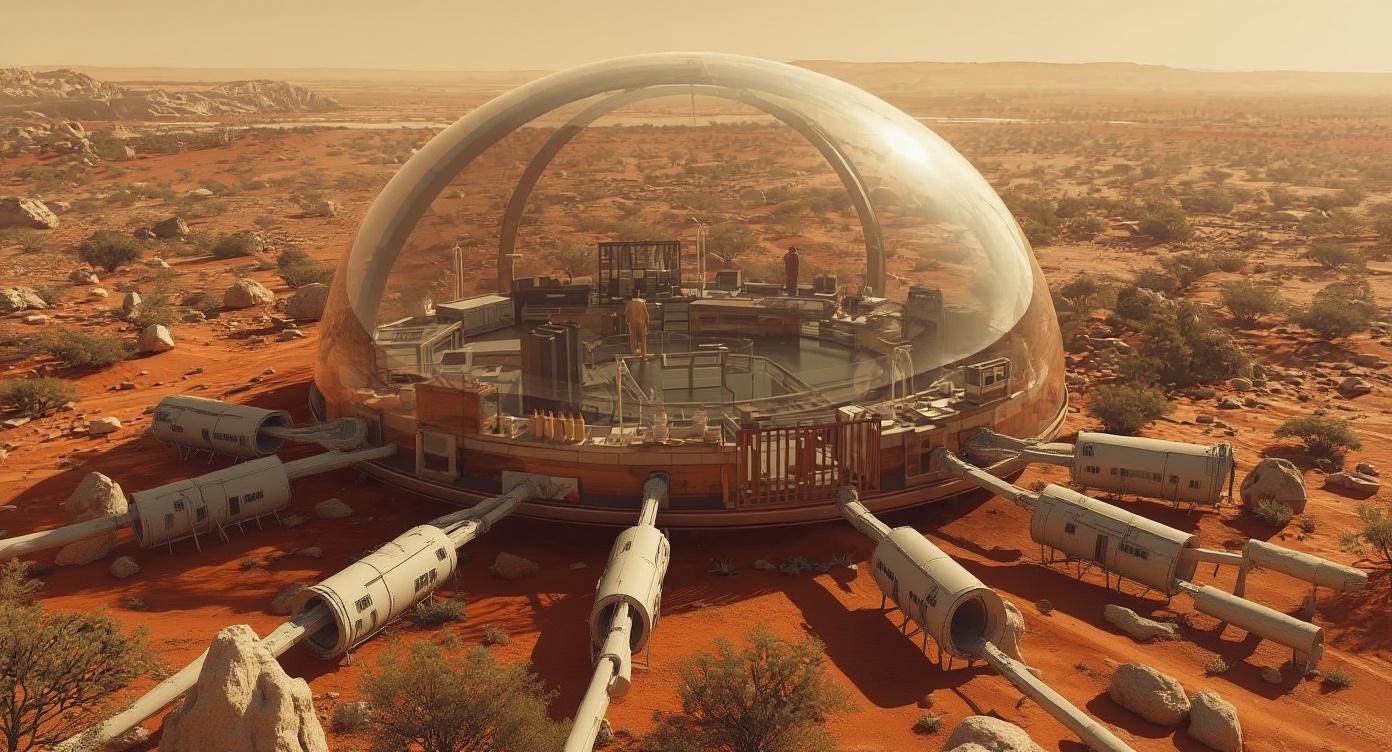
Whether it’s a being of flesh and bone or a data-based machine, every system is defined by its home environment. Colonizing Mars therefore does not simply mean landing on another planet — it means creating an entirely new type of human and a society perfectly adapted to its new home.
The Environment Shapes Everything
Our planet is home to billions of people, yet no two are exactly alike. Although we share the same biological foundation, each of us is uniquely molded by a force that constantly surrounds us — the environment.
The environment is not just the backdrop to our lives. It is a relentless sculptor shaping our bodies, cultures, and ways of thinking. This principle applies to every corner of Earth — and becomes even more profound when extended to life on another planet.
Examples from Earth: From Fields to Deserts
The Texan Farmer:
In the southern prairies of Texas, where the sun scorches and destructive tornadoes threaten, life is shaped by the struggle with natural elements. The farmer’s culture is based on self-reliance, hard work, and the ability to react swiftly to weather changes. His body is toughened by sunlight and physical labor. Life here is about endurance and defiance.
The Tibetan Farmer:
High in the mountains of Tibet, where the air is thin and temperatures plunge far below freezing, locals have evolved over thousands of years. Their lungs have greater capacity, and their blood cells have adapted to oxygen scarcity. Their deeply spiritual culture focuses on calmness — perhaps a psychological adaptation to the harshness of their surroundings.
The Inuit Hunter in the Arctic:
In the frozen Arctic landscape, life follows the rules of ice and snow. The Inuit (the preferred term over Eskimos) have physically adapted to the cold — their bodies are more compact, helping to retain heat. Their diet is rich in fats, and their culture is built on deep respect for nature and absolute cooperation.
The Egyptian in the Desert:
In Egypt’s unforgiving deserts, each day is a battle for survival. Life revolves around water and narrow oases. Human bodies have adapted to minimize water loss, and their culture evolved around the management and protection of this precious resource.
The Larger Context: Earthling vs. Martian
While the differences between Tibetans and Arctic peoples may seem vast, they are in fact small modifications of the same biological design.
All these people share the same planetary gravity and the same fundamental physical laws.
But a Martian? That’s a completely different case. As shown earlier, a person born on Mars would be shaped by an environment that is fundamentally alien. Their body would have to cope with unique challenges:
Gravity: Minimal gravitational pull would result in light, porous bones and weak muscle fibers, leaving them immobile on Earth.
Balance: The vestibular system would adapt to low gravity, making a return to Earth result in extreme disorientation and nausea.
Thus, the environment shapes not only the details of our existence but its very essence. While Earthlings are merely variations of the same species, a Martian would become an entirely new phenotype. Even technology that functions on Mars would have to evolve according to different physical laws.
Conclusion
Understanding how the environment shapes life is crucial.
Difference is natural.
Humans born on Mars would be fundamentally different — and they would rightly be called Martians. Not because of ethnic differences, but because they would be products of a new world and its unique physical laws.